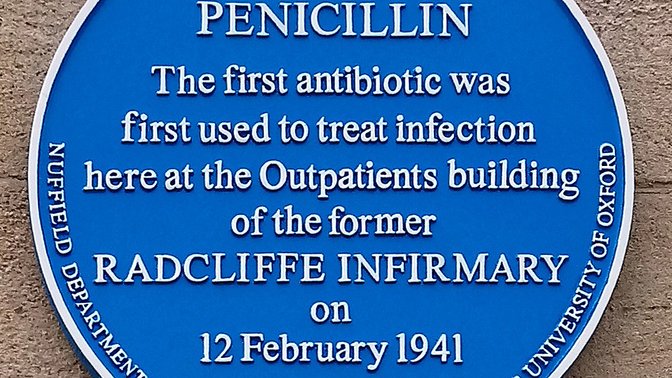
Blue Plaque: Penicillin
Oxford, GB
Details
A modest blue plaque at the former Radcliffe Infirmary marks a truly momentous event in medical history: the first clinical trials of penicillin in 1941. It was here that a team from Oxford University, led by Howard Florey, Ernst Chain, and Norman Heatley, took Alexander Fleming's chance discovery of penicillin and transformed it into a life-saving drug. Their pioneering work at the Sir William Dunn School of Pathology, and subsequently at the Radcliffe Infirmary, involved purifying the unstable substance and demonstrating its incredible power against bacterial infections. The initial trials, though fraught with challenges like limited supplies, offered a glimmer of hope, famously treating police constable Albert Alexander who had a severe infection. This Oxford-based research effectively launched the antibiotic age, forever changing the fight against diseases that were once deadly.
The development of penicillin in Oxford, a collaborative effort under the difficult conditions of wartime, is a compelling story of scientific dedication and innovation. The team at the Sir William Dunn School of Pathology ingeniously scaled up production from laboratory curiosity to a substance that could be used in human trials, even using makeshift equipment. While Fleming first observed penicillin's effects, it was the Oxford scientists who rigorously developed it into a usable treatment, a feat for which Florey and Chain, alongside Fleming, received the Nobel Prize in 1945. Today, two blue plaques in Oxford – one at the Radcliffe Infirmary site (now part of the Nuffield Department of Primary Care Health Sciences) and another at the Sir William Dunn School of Pathology – commemorate this world-changing breakthrough, reminding visitors of the city's crucial role in a discovery estimated to have saved hundreds of millions of lives.
Comments
Comments will appear here soon.